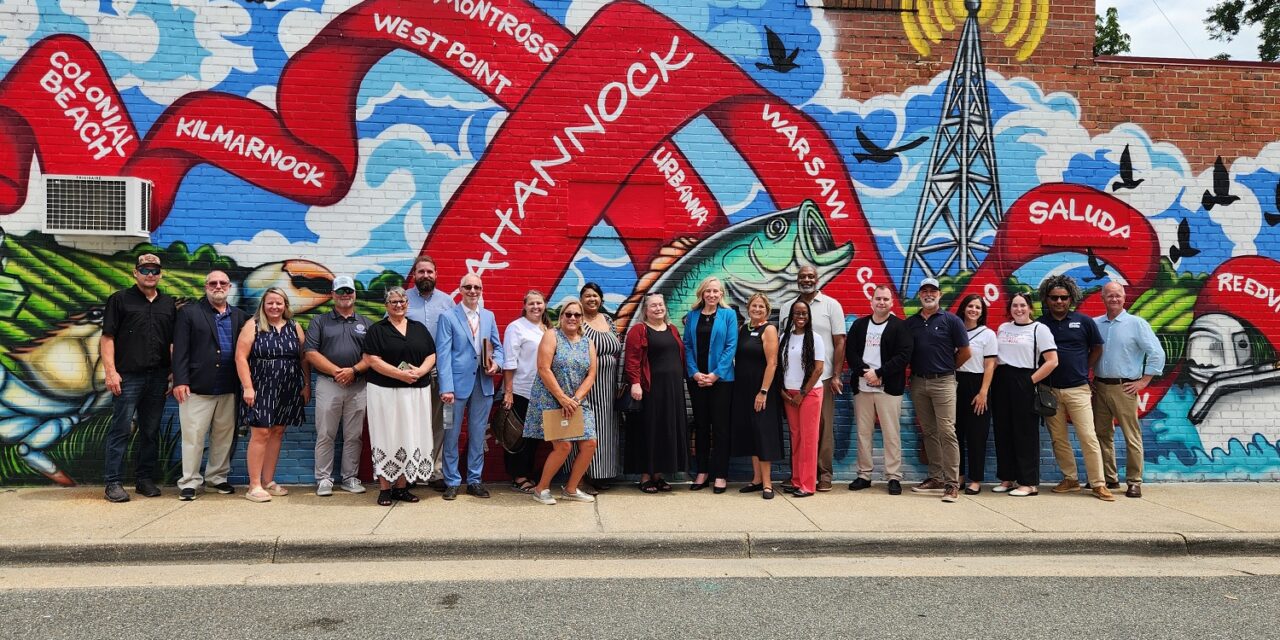
TAPPAHANNOCK, Va. — August 15, 2026 — The Tappahannock Artists Guild (TAG) welcomed Governor Abigail Spanberger and state leaders to its downtown gallery this week, offering an opportunity to see firsthand how investments in the arts can generate benefits far beyond the walls of a gallery.
Since establishing a permanent presence in downtown Tappahannock, TAG has grown into a community arts center showcasing the work of more than 50 local and regional artists each year, offering classes and workshops, developing programs for young people, and producing events that bring residents and visitors into downtown Tappahannock.
That work is also part of a much larger economic story.
According to the National Endowment for the Arts and U.S. Bureau of Economic Analysis, arts and cultural production contributed approximately $21 billion to Virginia’s economy in 2023, accounting for 3 percent of the state economy and supporting nearly 118,000 jobs statewide. Nationally, arts and cultural production contributed $1.2 trillion to the U.S. economy in 2023, or 4.2 percent of GDP.
For small communities like Tappahannock, the creative economy can have an especially visible impact. An art opening, class or festival doesn’t end at the gallery door. Visitors eat at local restaurants, shop in downtown stores, stay in area lodging and discover other businesses and attractions.
“TAG is an arts organization, but we are also a small business, an employer, an event producer and a downtown destination,” said Paige Conner Totaro, Executive Director of the Tappahannock Artists Guild. “When someone comes downtown for an exhibition opening or one of our events, we hope they don’t just visit TAG. We hope they have dinner, visit another shop, bring friends back with them and begin to think of Tappahannock as a place where things are happening.”
Research from Americans for the Arts reinforces that effect. Its Arts & Economic Prosperity 6 study found that nonprofit arts and culture organizations and their audiences generated $151.7 billion in economic activity nationwide in 2022, supporting 2.6 million jobs. More than half of that activity, $78.4 billion, came from audience spending associated with attending arts and cultural events.
TAG’s own growth illustrates how relatively modest public investments can help small community organizations build capacity.
Support from the Commonwealth, including funding for arts and downtown revitalization, has helped TAG expand programming and strengthen its role in Tappahannock’s historic downtown. Through Virginia’s Main Street program, TAG also received professional façade design assistance at no cost, giving the organization access to expertise that would otherwise have been difficult for a small nonprofit to afford.
These programs demonstrate the multiplier effect of public investment: state support helps a local organization improve its facility and programming; that organization supports working artists and instructors; exhibitions and events attract visitors; and those visitors support surrounding businesses.
TAG has also expanded educational opportunities, increased the number of exhibitions and workshops it offers, and created events that connect the arts with the broader downtown economy. Its annual plein air activities, exhibition openings and participation in community events help bring hundreds of people into Tappahannock while creating opportunities for artists to sell their work and build sustainable creative careers.
The organization is now working to expand its facility to provide dedicated classroom and studio space, allowing TAG to offer more art education, workshops and opportunities for working artists.
TAG is also part of a growing network of arts and cultural organizations throughout the region. Projects including the restoration of the historic DAW Theatre and the development of new creative spaces elsewhere in the Northern Neck point to the potential for arts and culture to become an increasingly important component of the region’s tourism and economic-development strategy.
“The creative economy matters everywhere, but it can be particularly powerful in a rural community,” Totaro said. “We may not be recruiting a thousand-person corporation to Main Street. But we can help create dozens of opportunities for artists, teachers, makers and entrepreneurs, while giving people more reasons to visit, spend money and choose to live here. That kind of economic development grows from the character of the community itself.”
TAG’s experience reflects a broader principle increasingly recognized by economic-development organizations: investments in arts and culture are not simply investments in amenities. They are investments in small businesses, tourism, workforce attraction, entrepreneurship and vibrant downtowns.
For Tappahannock, that means the arts can help build both a stronger community and a stronger local economy.